
NORTHGLENN, COLO.—AUG. 1, 2026
A whole season in an afternoon
Twenty-eight games, five Killshot doctrines and a tournament nobody wanted to play.
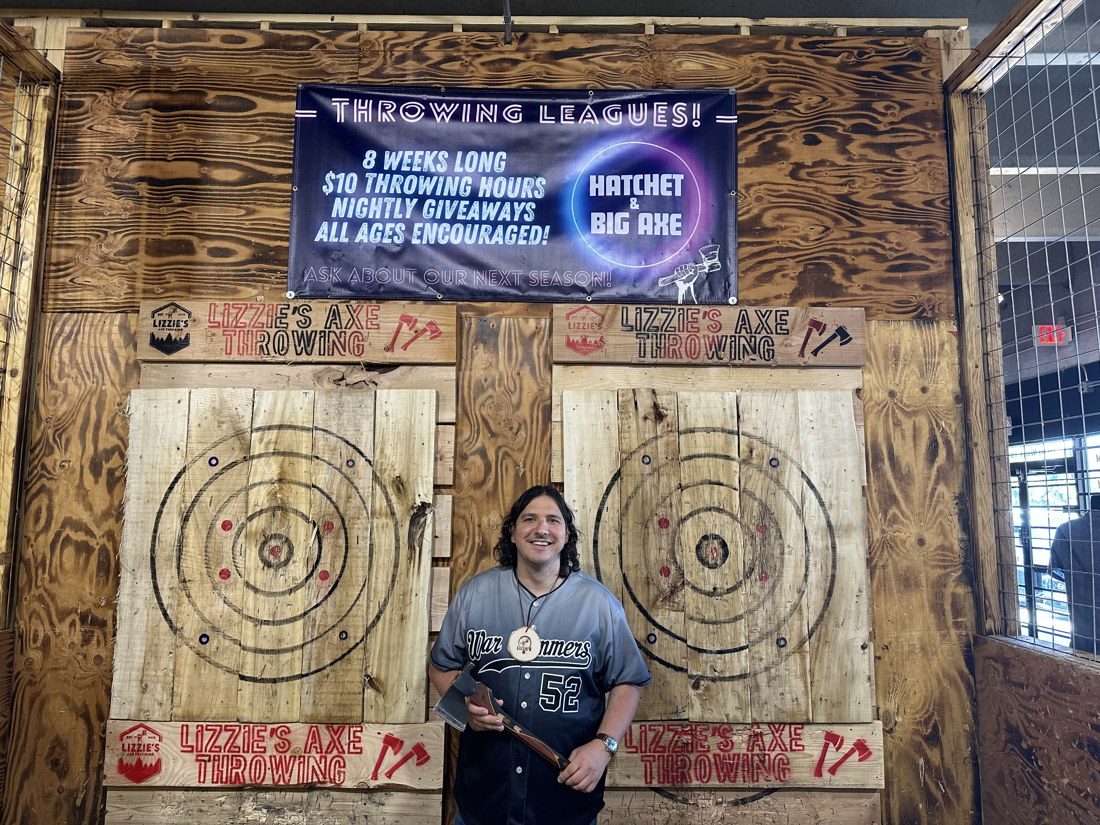
There is a version of axe throwing you already know about. A bar, a birthday, a lane rented by the hour, somebody's cousin flinging a hatchet at a slab of wood while everyone cheers when it sticks.
Underneath that there is a second version. It has governing bodies, rulebooks revised every year, three competitive divisions, a world championship, and a target specified so precisely that the rules dictate which kind of pen you outline it with.
And underneath that there's a third thing, older than both, which David Dannenberg brought up unprompted at the end of an interview.
“I prefer the mountain man rendezvous aspect,” he said. “You ever done it?”
That's the lineage — the tomahawk, the rendezvous, men throwing steel at wood for two hundred years before anyone thought to put a bar next to it. The organized version is young — the earliest press AXEOLOGY has found dates to 2010. [Vice, August 26, 2010.] The act is not.
On Saturday, August 1, a small group spent five hours in Northglenn, Colorado, on the second version.
A note on how this was reported, before any of it. Three of the people quoted here — Micah Fonoroff, Tina Rivera-Locklear and Scott Schell — are the three owners of the building the marathon was thrown in. Schell also competed, and posted the best twenty-eight games of the day. The results this piece rests on came from Rivera-Locklear, who built and ran both marathons, rather than from the governing body directly. The reporting was assisted by AI, which the sources were told at the time. None of that makes the numbers wrong. All of it is worth knowing before you read them.
Start with the board
Everything in this sport comes from the target, so start there.
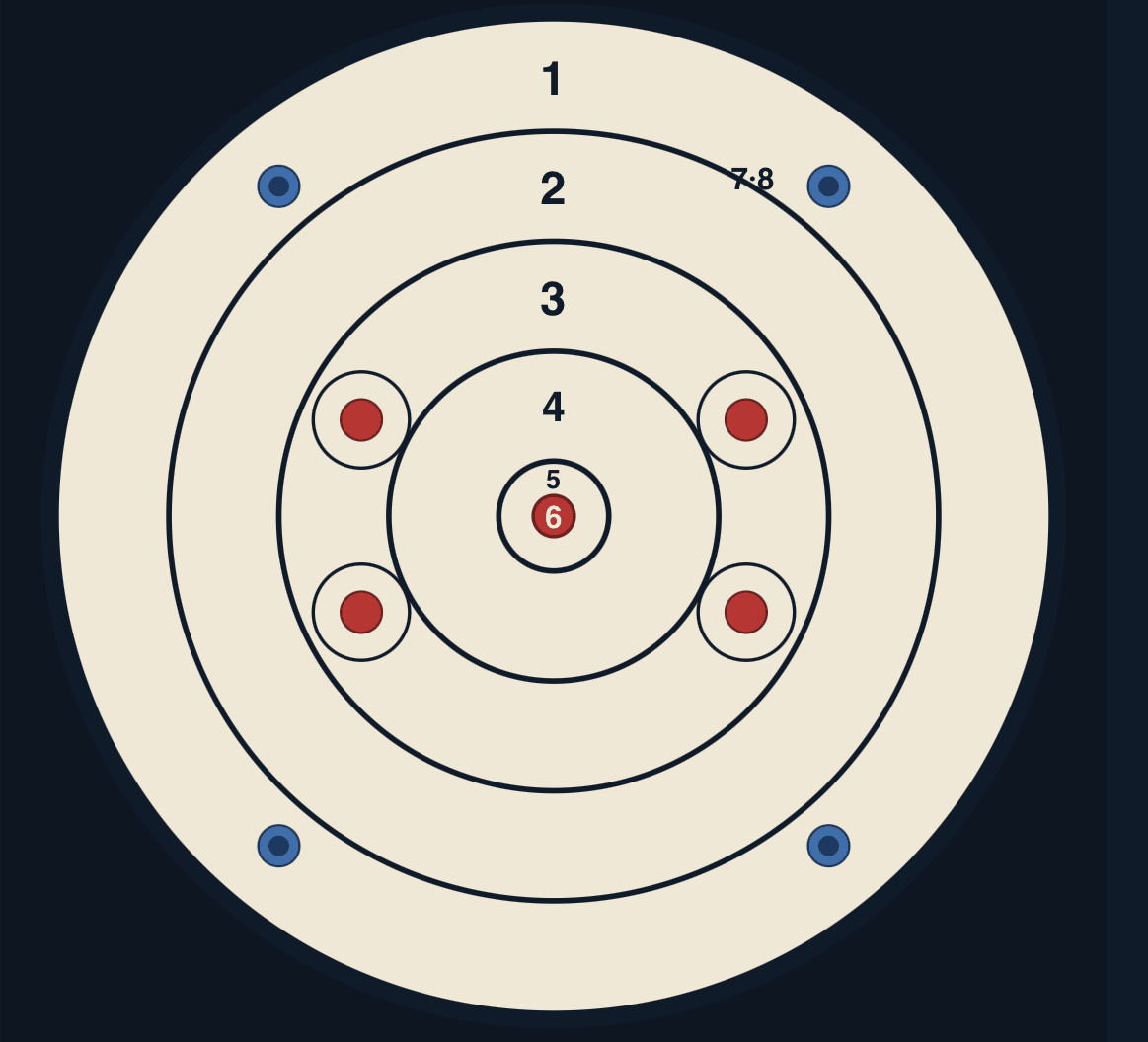
It's a slab of end-grain wood, three feet across, with five black rings drawn on it in marker twenty millimeters thick. The outermost ring scores one point. Working inward: two, three, four, five.
Most people assume there's a bullseye in the middle. There is. What surprises people is that there are five of them.
One sits dead center, an inch and a half across, red, worth six. The other four are spaced around it inside the three-ring — same size, same color, same six points. Each of the five sits inside its own five-ring.
So the board doesn't reward one perfect spot. It rewards five, and a thrower chooses which to hunt.
Then the Killshots. Four small blue circles out near the corners of the outermost ring — two up at seventy-two inches and two down at forty-eight, above and below the scoring rings. They're the only zones worth more than a bullseye.
They are also tiny. The outer Killshot is an inch and a half across. The inner one is three-quarters of an inch — smaller than a quarter. You are throwing an axe at it from twelve feet away. On purpose. [WATL 2026, §A.4.]
And they're worth nothing unless you say so first.
The thing that makes it a sport
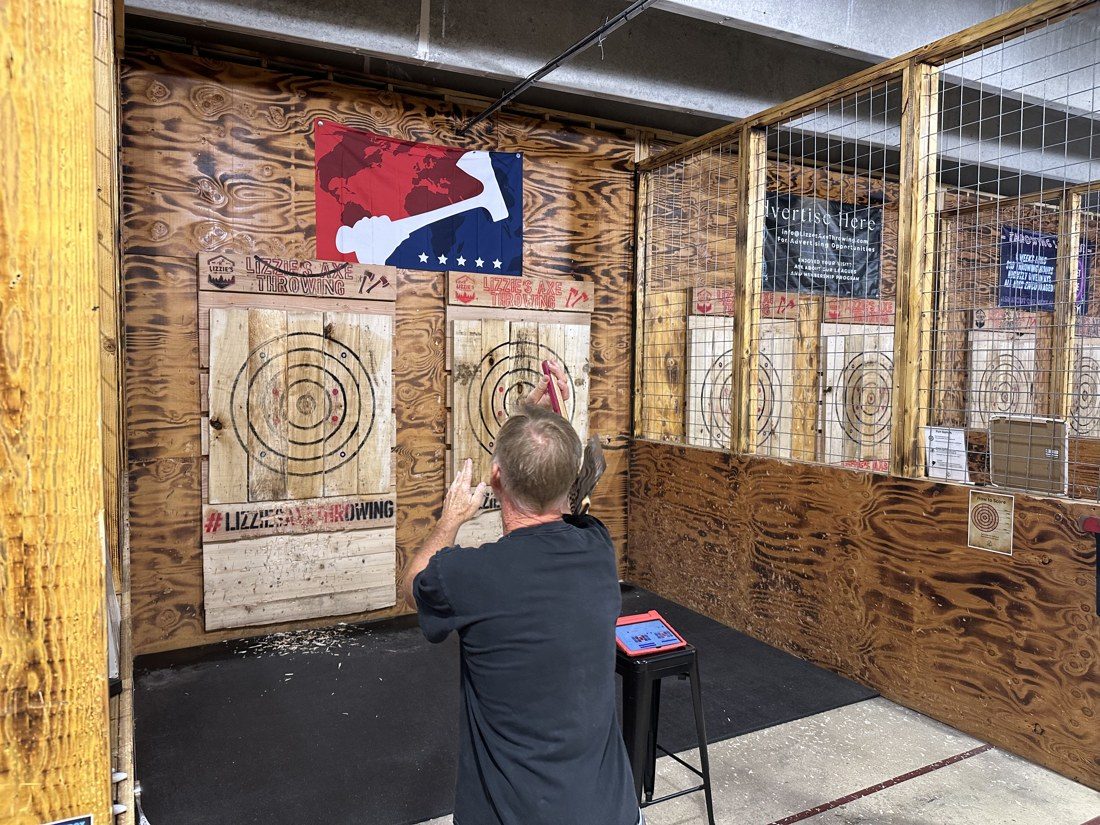
A Killshot must be called — out loud, before the axe leaves your hand. Hit it after calling it and you score seven or eight, depending on which ring you catch. Hit it without calling it and you score one, because you landed in the one-ring. Call it and miss and you take a zero on a throw that would otherwise have been a six.
You get two calls per game.
That's the whole sport in one mechanic. Not can you hit it but will you announce that you're going to, and then do it. Every strategic conversation in axe throwing descends from that rule, and no two throwers interviewed for this piece agreed on how to use it.
A game is ten throws — five at one target, then you switch sides and throw five more. Twelve feet from the board. Tied after ten and you go to sudden death: Killshots only, rotating clockwise around the four, until somebody outscores the other. [WATL 2026, §B.4.]
Throwers have their own name for that moment.
“Normally, people say Who Sucks Less,” said Logan Reid. “Sometimes it turns into a sort of chant or cheer.”
Two people have thrown ten axes each and finished exactly level, and the room's response is to announce that what follows will settle which of them is worse. It is the most honest thing anyone says all night.
A perfect game is sixty-four. Eight bullseyes and two called Killshots.
And the board gets harder as you get better
Here's the part that surprises people who thought this was a bar game.
WATL runs three divisions, and they don't change the target. They change what it's worth to you.
In Recreational, everything stays live. Hit the center bullseye ten times, score ten sixes.
In Amateur, each bullseye and five-ring closes once you've scored it.
The rulebook's own phrase is that each bullseye and five-ring “closes out” once scored in a half. Think of the five bullseyes as five lights: hit one and it goes dark until the players switch sides. Throw into a dark one and it only pays what the ring it sits in is worth — a closed six with its five still open scores five, and a closed outer five scores three, because the outer fives sit inside the three-ring.
In Professional, hitting anything inside a five-ring closes that entire ring for the half — and hitting inside it again scores zero. Not a reduced score. Zero. The same as throwing your axe into the floor.
Everything reopens when the players switch sides.
What a marathon is
A league season is eight weeks. Four games a night, seven weeks of them, then a tournament in week eight.
A marathon is that same season thrown in one afternoon. Twenty-eight games, back to back, then the tournament.
“A lot of people like them because they get them done in one day,” said Micah Fonoroff, one of three owners at Lizzie's. “Time commitment's a lot easier. And if you're having a good day, you can just boom, knock them out and do really well.”
It changes the room. “It's not as social of an event,” Fonoroff said. “It's fast paced. It's get it done, because we know it's going to take a long time. It's a lot more let's get it done than the giggles and fun.”
You need four throwers minimum — a league rule, not a house rule.
And it is not a cheap way to spend a Saturday. “It's cheaper than shooting,” Fonoroff said, “because we get to retrieve our axes. We don't have the ammo problem. But it's still not cheap. You need to pay for lane time, and lane time is expensive. We have boards and rent and all that other fun stuff that needs to get paid for.”
Fonoroff throws Infinity axes and makes his own handles out of dowels from the hardware store. He is aware of how he sounds about it. “This is a commercial for Infinity, and I do not get paid by Infinity,” he said. “The guy doesn't pay me.”
The day
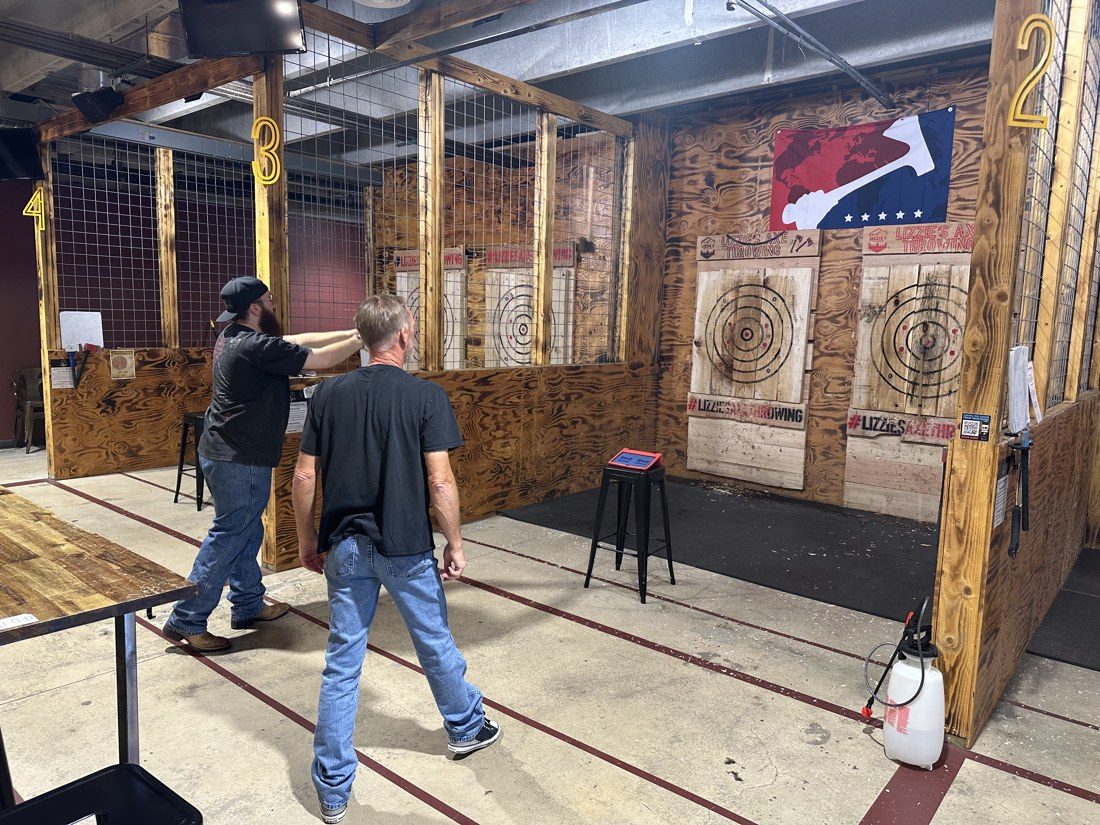
Tina Rivera-Locklear got to the building at eight in the morning. She checked the boards, watered them so the axes would bite, opened the register, set up the tablets and built both marathons in the league app. Rivera-Locklear is also one of the three owners, and has been the venue's main contact for leagues and marathons since November 2025.
Throwing started at nine.
Hatchet ran until about noon. Big axe from then until two. Six threw hatchet; four threw big axe.
Here is the whole hatchet field, from the results Rivera-Locklear supplied:
| Thrower | Venue | Div | W–L | Total | Avg | |
|---|---|---|---|---|---|---|
| 1 | Scott Schell | Lizzie’s Northglenn | Pro | 19–9 | 1537 | 54.9 |
| 2 | Rob Keller | American Axes, Arvada | Pro | 20–8 | 1512 | 54.0 |
| 3 | Jacob Hammers | Lizzie’s Northglenn | Pro | 18–10 | 1490 | 53.2 |
| 4 | Aidan Valois | The Axe and Ale, Fort Collins | Pro | 13–15 | 1424 | 50.9 |
| 5 | David Dannenberg | Lizzie’s Brighton | Am | 11–17 | 1352 | 48.3 |
| 6 | Vince Walker | Lizzie’s Northglenn | Am | 3–25 | 1208 | 43.1 |
Source: 2026 Season 3 hatchet marathon results, Lizzie’s Northglenn, supplied by the organizer. Twenty-eight games each. Placement is by total score, which is why the man with the best win–loss record is not first.
Running one doesn't take much staff, because of who shows up. “Most people that do marathons know what they're doing,” Fonoroff said. “We can judge each other. A lot of people that come to these are judges. I am a judge, so is Scott.” Two or three lanes, sometimes four.
By early afternoon the four big axe throwers had finished their seven weeks of games — and then agreed, without much argument, that nobody wanted to play the tournament.
“Everybody was tired after hatchet,” Rivera-Locklear said. “We were done.”
So the big axe marathon produced a full set of standings and no champion. A complete season with the last page torn out, because four adults on a Saturday were honest about being finished.
The man who won
Jacob Hammers threw his first axe on January 27, 2025. He can give you the date because friends were in town and suggested it.
“I fell in love with it immediately,” he said. He found Lizzie's near his house, took a membership, and came in constantly. “I didn't even know the rules at first, for like six weeks or so. I was just throwing at the middle bullseye, because I had no idea what the rules even were.” For a month and a half he was playing a game of his own invention, in a building full of people playing a different one.
Six weeks is a long time to keep showing up for a game whose scoring you have not learned. He is not unusual in that.
Aidan Valois got taken out one night by friends. “It just stuck, you know,” he said — a pun he did not appear to intend. Rivera-Locklear could not make an axe stick at all at first — and then she could, which was the whole thing. She was nowhere near a bullseye and she came back two weeks later anyway. Nobody in this field describes a gradual decision. They describe being caught.
Eighteen months later Hammers won the NoCo Open, and a week after that he won this tournament. He did not, however, post the best twenty-eight games of the day. That was Scott Schell, by forty-seven points. The marathon and the bracket are two different contests, and on August 1 they had two different winners.
August 1 did not start well. There was no warm-up period. “It ate me for breakfast,” he said. “I started with two forty-threes, which is not great for me. Missed a lot of my kills.” He locked in around the middle of the marathon.
He calls Killshots constantly, and not to win.
“My strategy is not really to win marathon league games. My strategy is to throw well,” he said. “If I were trying to win every game that I played, I would not be going up a hundred percent of the time. I would not even really be going up fifty percent of the time. But I wanted to throw well, and I know at the highest level I'll definitely need to be able to throw kills well. It's a real skill to be able to do so after throwing eight bullseyes, no matter what, every time.”
Ask him for the throw he'll remember and he doesn't pick a good one.
“One of my very first kills — I'd missed two or three at that point. And I finally hit one. I hit it dead on. But the board was pretty hard and it just dropped right out. So I hit my first kill, which is a very good feeling to have, and then it didn't count.”
Under the rules, an axe that falls before the judge calls the score is a drop. Zero. A drop does buy you something back — it earns an extra Killshot call, at the opposite height, on any throw but the last. [WATL 2026, §B.5.]
Fifth place beat him anyway
David Dannenberg finished fifth of six. Somewhere in those twenty-eight games he also beat the man who won the tournament.
“Playing Jacob, when I beat him,” he said, asked for his memorable throw. “It was a fifty-four fifty-six. Hit the kill, got the eight.”
Dannenberg has been throwing about five years. He calls half his Killshots in a marathon “regardless of how well my score is — it's overall practice, just to try to get to that edge.” Asked whether he called any he shouldn't have that day, he didn't hesitate: “A lot.” He did not elaborate. He did not need to.
The other axe
The big axe is not a heavier hatchet. It's a separate discipline, and the differences are more interesting than the weight.
A competition hatchet can weigh no more than three pounds and be no longer than nineteen inches. A big axe starts at three pounds and runs to four and a quarter, on a handle between twenty-three and thirty inches. You throw it from fifteen feet instead of twelve.
Then the target changes on you. In big axe, the four outer bullseyes and their five-rings are switched off. Only the center scores them. A game is seven throws, not ten, and all four Killshots are worth eight, with none of the seven-point distinction that applies in hatchet.
Aidan Valois, who threw both disciplines that day, thinks that makes it easier — and his reasoning is the rulebook.
“Big axe is far easier than hatchet, in my opinion,” he said. “It's definitely a lower skill ceiling, because you only have to go for the one bullseye. And fours are a lot more common.”
Rivera-Locklear, who threw twenty-eight games of big axe that afternoon, describes the cost in the arm: “The big axe is a little heavier, so it takes a little bit more oomph. It takes a little extra — not strength, just a little stronger throw. I do get tired more in big axe than I do in hatchet.”
Both are right, because they're measuring different things. Fewer targets and a bigger blade make it easier to score. A heavier implement and three more feet make it harder to throw. What tires you and what tests you are not the same measurement.
For Logan Reid it's specifically anatomical. “It puts a lot more strain on my shoulder. I got a bad shoulder, bad rotator cuff,” he said. “A hatchet throw doesn't use any of my shoulder — it's all tricep and forearm, mostly. Big axe is more involved.”
Hammers doesn't throw big axe at all now, and when he did he threw it two-handed, which is unusual. “My one-handed throw doesn't translate to big axe,” he said. “What it will punish is if you've got more wrist motion in your throw, like I do. It doesn't lend itself to that.”
Two out of three
Only the first seven weeks are individual games. Week eight is a tournament, and Rivera-Locklear builds it.
“The app asks how many games do you want to do — best two out of three? Do you want it to be single elimination or double elimination?” she said. Players are seeded on their scores and win record across the first seven weeks, then the bracket runs like a basketball draw: top seed against bottom seed.
August 1 was a single-game, double-elimination tournament. That resolves a contradiction in the reporting for this piece — two competitors described the format differently, one saying single and one saying double, and each was describing half of a compound answer.
When to go up
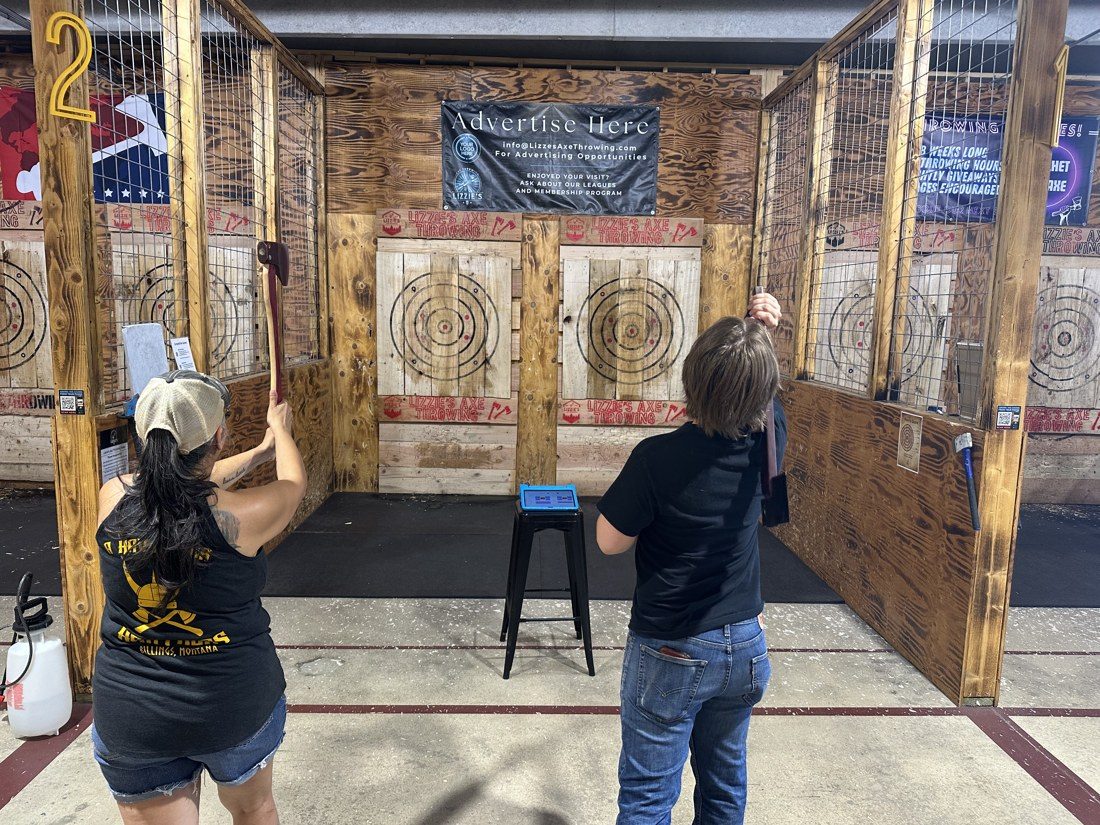
“Going up” is what throwers call announcing a Killshot.
“If I notice at the end of throw eight I'm behind three points, then I'll go up on throw nine to try to catch up,” Rivera-Locklear said. “If I'm ahead on nine by three points, I'll generally stay down.”
She describes three points as close to a shared convention. Down three, go up. Up three, stay down. In between, it's a read on the person beside you.
“If I know my opponent and my opponent generally doesn't make his or her Killshots, I'll probably stay down. If I think they're going to hit it and I absolutely have to hit it, then I have to go up.”
In big axe the same arithmetic arrives sooner, because there are only seven throws. “At throw five you're starting to think about what you're going to do on six and seven.”
Reid has the cautionary version. “I totally did the math wrong,” he said of a previous match. “Thought I was ahead by enough points, and I wasn't. Went up, missed. Thought I smoked it, and then I was out.” Had he stayed down, he'd have won.
Scott Schell — a co-owner who also competed in the field — called about half of his that day and went up on ten every time. He'd called all of them at a marathon two weeks earlier, and calls all of them on league night. What changes his mind isn't the score.
“When it augments, it's because one of my peers has sucked me into doing something,” he said. “If I'm throwing fifty percent and let's say I'm playing Micah or Jacob, they'll say up on nine and ten — and I'll go up on nine and ten.”
Valois calls all of his, always on nine and ten. “If I miss it on five, then I lose all my momentum to win the game.”
Reid, still adjusting a new throw in big axe, barely called any. “I'm scared of Killshots,” he said. “I don't want to hit any screws or go too low.”
Four throwers. Four incompatible doctrines about the same blue dot.
What the scorecard doesn't show
Schell was asked what he sees from the floor that a scoresheet can't.
“Not only all the dynamics of my own throw, but the dynamics of who I'm playing,” he said. “There's competitors that come here that you can get them out of their game pretty easily. Just by saying one or two words you can change them from throwing scores in the sixties to bring them down to the high forties. Just with a couple words.”
He named nobody, and declined to.
“It's a lot mental,” he said. “When you're throwing, you've got to pretty much throw by yourself, play your game and not play the competitor next to you.” He said people get visibly nervous at the last two throws, and that his own Killshots take longer than his ordinary throws — he's making sure his body is set.
Reid's answer was simpler. Asked for his most memorable throw of the day: “My first one went way high, hit a one. So that was cool. I don't hit many ones, but when I do, they're pretty cool.” A one is the lowest score on the board that isn't a zero.
What they'd change
Ask this field what they'd fix about the scoring and the same answer keeps arriving from people who didn't discuss it with each other.
Hammers described the mechanism from inside it. “Particularly at the very high level, games can get very predictable. If it's just six, six, six, six, six, you know it's a one or two point game every single time going into throw nine and ten. Which gets very repetitive.” What he wants back is the 2025 target: “those dime-sized outer bullseyes, so that it differentiates the very top level even better.”
Rivera-Locklear, unprompted and separately: “I think I would make the five ring a little bit smaller on the outside bullseyes. Which would make it just a little bit harder to get a decent score. If the five is a little bit harder to hit, you're going to try to zone in on that six a little bit more.”
And Schell has the strangest evidence of the three, because he built an instrument for it. In a workshop he shares with his son he has an end-grain board with sixty small targets drawn on it — ten to a row, all at regulation heights, nothing full-size.
“I hit those when I go over there and practice,” he said. “And then I'll come throw these full size and I'll be all over it.”
Practicing on the small targets taught him something about the real board. “This is where I learned how close the middle bullseye and the top and the bottom bullseyes are. They're only like that far apart. So when I adjust, it's just that much.”
He puts it this way: “If you look at my Killshot percentage and you double-click into it, I hit more eights than I do sevens. And a lot more.” The eight is the smaller target.
Three people. One answer. Nobody coordinated it.
The sport argues with itself
None of this is settled, and the rulebook keeps moving. In 2026 WATL revised the outer bullseye and five-ring positions, and split the outer Killshot to seven points while the inner stayed at eight. [WATL 2026, “What's New.”]
Fonoroff, asked what changed after the 2024 revision, is more ambivalent than nostalgic. They “got away from the dimes,” he said, and the result is “a lot less confusing in some manner, and it's even more confusing in another.”
What he does remember as a genuine fight was the fifteen-foot rule — a requirement that applied to pros and not to amateurs.
“That was a point of contention,” he said. “Oh, I've got to go buy a whole new axe so I can have my recurve or my longer handle.” Some throwers avoided the purchase by flipping the axe around and throwing it backwards — which collided with venue safety policy. “I've seen some venues that have explicit signs that say you're not allowed to throw any trick shots. That's considered a trick shot. They specifically say the blade has to be facing downrange, not towards you.”
Which left those venues with three options, as he put it: “They either needed to change their rules, update their insurance, or break their rules, honestly.”
That is what a young sport looks like from the inside — a rules committee, an equipment cost, an insurance policy and a safety sign, all in tension over three feet of floor. The pen specification is starting to look reasonable by comparison.
The thing a scorecard can't hold
Rivera-Locklear had five straight sixes going in big axe, down the middle, one after another. Two called Killshots and she'd have thrown the first perfect game of her life.
“Going into throw six, I missed my Killshot,” she said. “Takes the pressure off — I'm not going to get a perfect game. And then I throw another six.”
She started in 2020, when she booked a lane on Colfax for her fifty-first birthday and brought ten friends.
At first she couldn't make the axe stick at all. Then she could — and that, not the score, was the thing. “Once I started getting it to stick, I was like, man, this is so much fun,” she said.
“I wasn't anywhere near the bullseye, but I was still having a really good time.” She came back two weeks later, a coach asked whether she knew there was a league, and she's been in one ever since.
Before that she spent seven years in the Army — a Hawk missile crew member, then patient administration in a hospital. She thinks it explains the practice. Preparing for her first world championship she threw four hundred axes a day, five to seven days a week. In April 2027 she goes to her fourth.
“The score sheet itself is very black and white without the personality of the thrower,” she said. “You don't get the setup, and the frustration of a missed hit, or the excitement of a Killshot.”
That's what she says she likes about standing on the floor of a marathon instead of reading the results afterward. Somebody's first perfect game. Somebody's first Killshot. Somebody's first fifty.
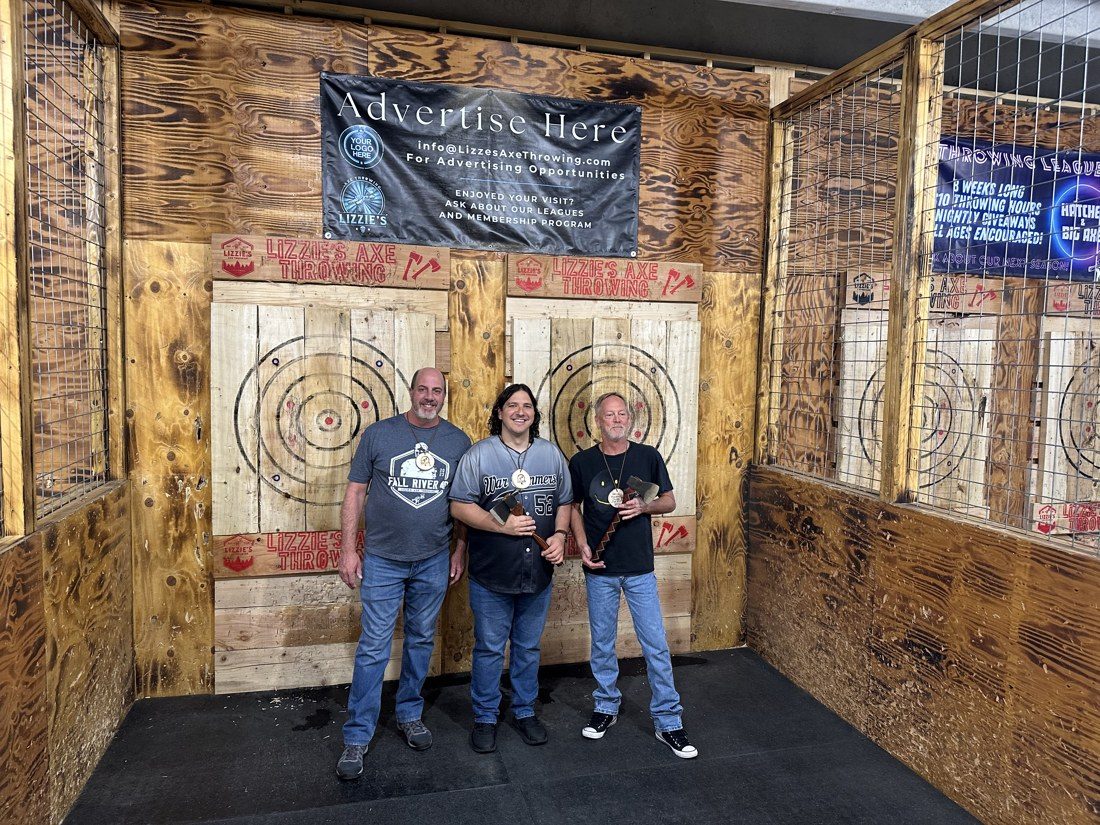
“You get to celebrate those things with them as it happens.”

AXEOLOGY is published by AXELETE. Its editor founded Axes of Faith, which holds a venue partnership with Lizzie’s Axe Throwing. AXEOLOGY does not review, rank or rate venues.